An illustrative flowchart depicting concepts related to seagrass assessment, conservation, and reintroduction in a stylized green and blue palette.
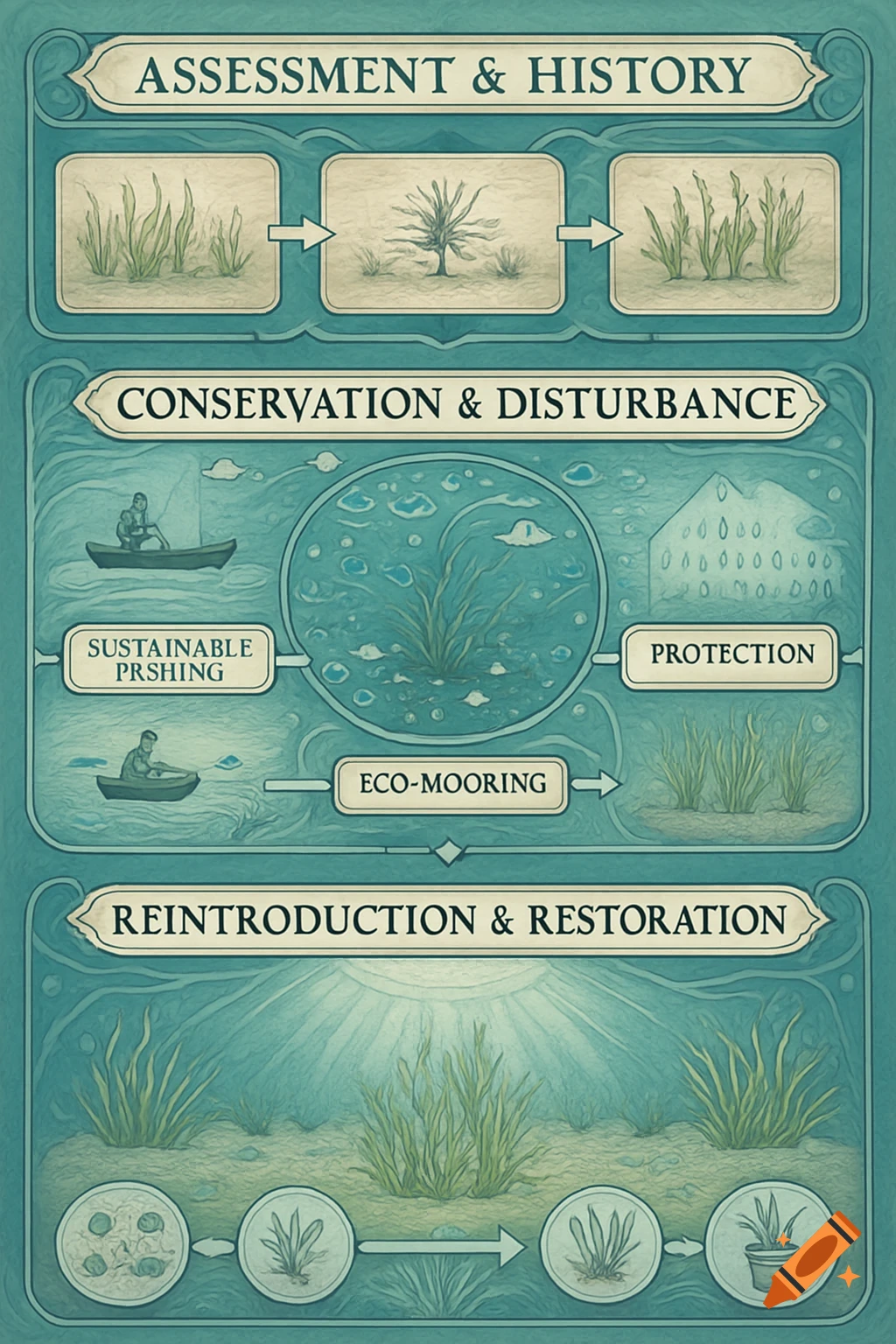
The flowchart can be divided into three main sections: Assessment & History, Conservation & Disturbance, and Reintroduction & Restoration. 1. Initial Assessment and Historical Context The process begins by assessing the past and present status of seagrass at the site: Historical Seagrass Populations? (Decision Point 1): Yes: Proceed to check for Current seagrass populations? No: The decision chart directs to Use historical/paleological data to inform reference ecosystem (referencing Ch. 2 of the document) and then to the question Current seagrass populations? Current Seagrass Populations? (Decision Point 2): No: The next step is to determine if Reintroduction or enhancement required (which is a green action box). Yes: Proceed to check for Seabed disturbance? Side Action: If the answer to Historical Seagrass Populations? was No, and the answer to Current Seagrass Populations? is No, the chart directs to Determine existing population density and structure before proceeding to Reintroduction or enhancement required. 2. Conservation and Disturbance Assessment If current seagrass is present, the focus shifts to management and threats: Seabed disturbance? (e.g. due to fishing or anchoring) (Decision Point 3): Yes: The action is to Engage with stakeholders to reduce disturbance (e.g. Eco-Moorings), followed by Mitigate negative impacts or conduct restoration in a protected area (a green action box). No: Proceed to check the Conservation designation status? Conservation designation See more