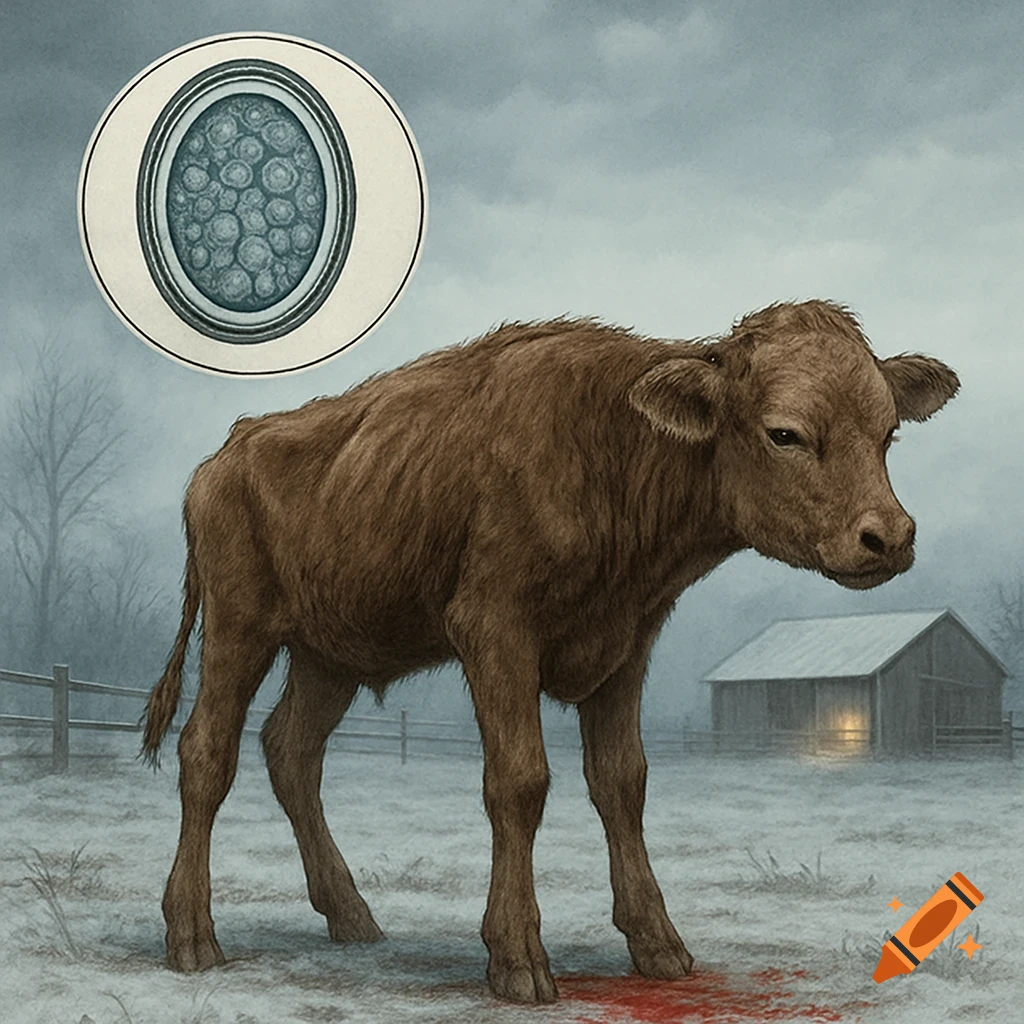
A brown calf stands in a bleak, snowy field with a small puddle of blood on the ground. An inset circle shows a microscopic view of oocysts.
Coccidiosis Large Animals • Coccidiosis is usually an acute invasion and destruction of intestinal mucosa by protozoa of the genera Eimeria or Isospora, Other genera, of both hosts and protozoa, can be involved (Cryptosporidiosis, sarcocystosis, Toxoplasmosis) • Coccidiosis is seen universally, most commonly in young animals confined in small areas contaminated with oocysts, clinical coccidiosis is most prevalent under conditions of poor nutrition, poor sanitation, or overcrowding, or after the stresses of weaning, shipping, sudden changes of feed, or severe weather. Clinical Findings:- • Clinical signs of coccidiosis are due to destruction of the intestinal epithelium and, frequently, the underlying connective tissue of the mucosa. • This may be accompanied by hemorrhage into intestinal lumen, catarrhal inflammation, & diarrhea. • Signs may include discharge of blood or tissue, tenesmus, and dehydration. • Nervous signs (eg, muscular tremors, hyperesthesia, clonic-tonic convulsions with ventroflexion of the head and neck, nystagmus) and a high mortality rate (80%–90%) are seen in some calves with acute clinical coccidiosis. Outbreaks of this “nervous form” are seen most commonly during, or after, severely cold weather in midwinter in Canada and the northern USA; there are no reports of the “nervous form” outside this geographic location. Oocysts of Eimeria zuernii in a fecal smear from a calf. Isospora amphiboluri oocysts from a bearded dragon. Treatment:- • Soluble See more